
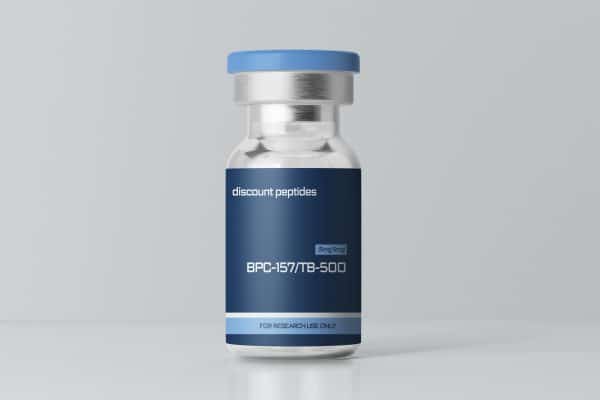
BPC-157/TB-500 (5mg+5mg)
$73.00
RESEARCH USE ONLY
10 in stock (can be backordered)
Description
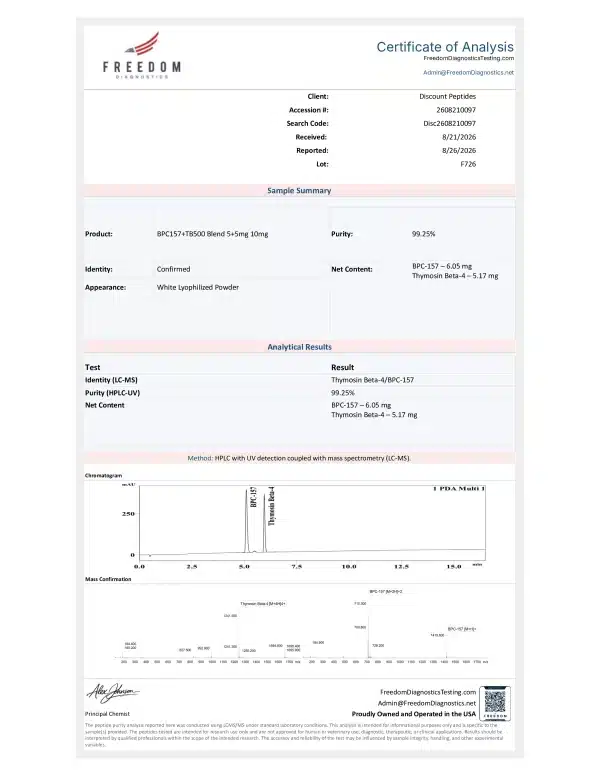
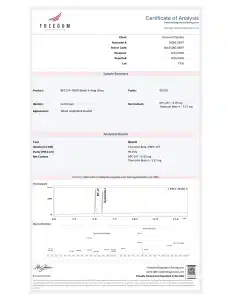
To confirm authenticity, see the Registered Certificate of Analysis on the THIRD PARTY testing lab website:
https://coas.freedomdiagnosticstesting.com/Disc2608210097.pdf
Click here to view and download the THIRD PARTY CERTIFICATE OF ANALYSIS.
The Wolverine Blend combines two experimental peptides — BPC-157 and TB-500 — and is primarily associated with research into tissue repair, connective tissue, vascular signaling, and recovery.
The name “Wolverine” comes from the research-peptide community rather than from a formal pharmaceutical designation. Importantly, the two peptides have been studied separately far more extensively than they have been studied together. There is currently no controlled clinical trial establishing that the combination works better than either peptide alone.
Product Information
BPC-157 is a 15-amino-acid peptide investigated mainly in preclinical models of tendon, ligament, muscle, gastrointestinal and vascular repair. TB-500 generally refers to a synthetic fragment related to thymosin beta-4 and is associated with research into actin signaling, cell migration, and tissue regeneration.
The combination is attractive because the proposed mechanisms appear complementary: BPC-157 is associated with vascular and cytoprotective signaling, while TB-500 is associated with actin-related cell migration and repair pathways. But this is a mechanistic rationale — not proof of synergy.
How Does the Wolverine Blend Work?
The blend pairs BPC-157’s proposed vascular/cytoprotective activity with TB-500’s actin-related cell-migration activity, creating a theoretical multi-pathway approach to tissue-repair research.
Wolverine Blend Benefits
Supports Tendon and Ligament Research
BPC-157 has generated substantial preclinical interest in tendon-to-bone healing, ligament repair, and connective-tissue recovery. Animal studies have reported improvements in healing markers and functional outcomes following tissue injury.
Supports Muscle and Tissue-Repair Research
Both constituents have been investigated in experimental models involving damaged tissues. TB-500/thymosin-beta-4 research particularly focuses on cell migration, wound repair, and tissue regeneration, while BPC-157 research has explored broader protective and healing pathways.
Supports Vascular and Angiogenesis Research
BPC-157 has been associated with VEGFR2/eNOS-related vascular signaling, while thymosin-beta-4 research has examined endothelial-cell migration and vascular repair. These pathways are part of the rationale for combining the two peptides.
Theoretical Complementary Action
The biggest attraction of the Wolverine Blend is the possibility of combining two different repair mechanisms. BPC-157 is primarily researched around vascular/cytoprotective signaling, while TB-500 is associated with actin dynamics and cell migration. However, no controlled study has established a synergistic dose or demonstrated that the blend outperforms either peptide individually.
Related products
-

TB-500(Thymosin B4 Acetate) (2mg)
$42.00 Read more Out of Stock -
BPC-157 (20mg)
$89.00 Read more Out of Stock -
KPV (10mg)
$59.00 Add to cart -
LL-37 (5mg)
$75.00 Read more Out of Stock